
Natural Hairline Design in Bodrum – How Is a Hairline Planned?
A successful hair transplant is not simply about how many grafts can be implanted. One of the most important factors in creating a natural-looking result is hairline design. The position, shape, density, direction and irregularity of the frontal hairline can influence the entire appearance of a hair transplant.
For patients considering a hair transplant in Bodrum, understanding how a natural hairline is planned can help them make more informed decisions before treatment. A hairline should not be copied from another patient, drawn as a perfectly straight line or positioned as low as possible simply because more grafts are available.
Every face is different. Age, forehead proportions, existing hair loss, donor capacity, facial structure and the possibility of future hair loss all need to be considered.
This guide explains natural hairline design in Bodrum, including how the position is selected, why single-hair grafts are important, how FUE and DHI can be used, what creates an unnatural result and why long-term donor planning matters.
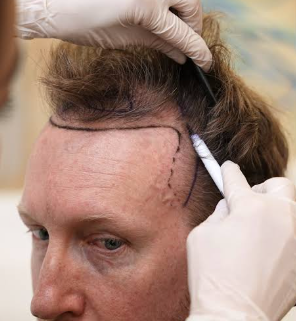
What Is Hairline Design?
Hairline design is the process of planning the frontal boundary of transplanted hair before a hair transplant.
Although it may appear to be a simple line drawn across the forehead, professional hairline planning involves several variables.
These include:
- Hairline height
- Overall shape
- Frontal curvature
- Temple recession
- Facial proportions
- Existing natural hair
- Hair calibre and texture
- Donor capacity
- Number of available grafts
- Direction and angle of implantation
- Patient age
- Expected future hair loss
The objective is not to create a mathematically perfect line.
Natural hairlines are not perfectly symmetrical. They contain subtle irregularities, variations in density and fine hairs around the leading edge.
Reproducing these characteristics is an important part of creating a hairline that does not immediately appear transplanted.
Why Is Hairline Design So Important?
The frontal hairline is one of the first areas people notice when looking at someone’s face.
Even a technically successful transplant can look artificial if the hairline is positioned incorrectly or designed without considering facial proportions.
Common problems can include a hairline that is too low, too straight, excessively dense at the front or inconsistent with the patient’s age.
Hairline design also affects the number of grafts required.
Moving a hairline forward by even a relatively small distance can substantially increase the recipient area. That additional area requires more follicles to create useful density.
For patients with limited donor capacity, an unnecessarily low hairline may consume grafts that could otherwise be used for the mid-scalp or crown.
This is why hairline design is both an aesthetic decision and a donor-management decision.
How Is a Natural Hairline Planned?
Planning usually begins by assessing the patient’s current pattern of hair loss.
The clinician examines the existing frontal hairline, temples, mid-scalp, crown and donor region.
The proposed design can then be discussed with the patient.
Rather than starting with the question, “How low can we make it?”, a more useful approach is:
Where should the hairline sit so that it looks natural now and remains appropriate as the patient gets older?
The answer is different for every patient.
Someone with mild frontal recession may need only restoration of specific areas. A patient with extensive Norwood-pattern hair loss may require complete reconstruction of the frontal zone.
Facial Proportions and Hairline Position
Facial proportions can provide useful guidance when planning a hairline, but they should not be treated as a rigid mathematical formula.
The clinician may consider the relationship between the chin, nose, eyebrows, forehead and scalp.
Forehead height also varies naturally between individuals.
Some people have always had relatively high hairlines, even before developing androgenetic hair loss. Attempting to create an unusually low adolescent hairline may therefore look inconsistent with their natural facial structure.
The goal should be balance rather than a predetermined measurement.
How Low Should a Hair Transplant Hairline Be?
There is no universal ideal height.
This is one of the most important concepts for patients researching hairline design in Turkey.
A 25-year-old and a 55-year-old should not automatically receive the same design. Nor should two patients of the same age receive identical hairlines.
The position needs to consider the patient’s original hairline, facial proportions, current hair-loss pattern and likely future progression.
A very low hairline requires more grafts.
It can also become increasingly difficult to support if natural hair behind the transplanted region continues to recede.
A slightly more conservative hairline may therefore provide better long-term balance for some patients.
Why a Perfectly Straight Hairline Can Look Artificial
Natural hairlines are rarely perfectly straight.
When viewed closely, the transition from forehead to hair usually contains small variations.
These subtle irregularities help soften the border.
A transplant designed as a ruler-straight, sharply defined line can sometimes produce an artificial or “drawn-on” appearance.
However, this does not mean the hairline should be randomly irregular.
Natural design requires controlled variation.
The overall shape still needs to follow the facial structure while smaller irregularities can help create a softer transition.
Why Single-Hair Grafts Matter
Follicular units can contain different numbers of hairs.
Some contain one hair, while others may contain two or more.
For the very front of a natural hairline, carefully selected single-hair follicular units are generally particularly valuable.
Why?
Because the leading edge of a natural hairline tends to appear softer and finer.
If thick multi-hair follicular units are placed directly along the front edge, the result can appear coarse or plug-like.
Multi-hair grafts can be useful farther behind the hairline where additional density is needed.
This creates a gradual transition from softer frontal hairs to greater density behind them.
Hair Direction and Angle Are Critical
Hairline design is not only about where follicles are placed.
It is also about how they emerge from the scalp.
Natural frontal hairs generally grow at relatively acute angles rather than pointing vertically upward.
Direction can also vary as the hairline moves toward the temples.
If transplanted follicles are implanted at inappropriate angles, the hair may grow in a direction that is difficult to style and visually unnatural.
This is particularly important around the temples.
Temple reconstruction requires careful understanding of natural growth direction because hairs in this area can lie very close to the scalp.
Hairline Density: More Is Not Always Better
Patients often ask for maximum density.
But natural-looking density is not created simply by placing the highest possible number of grafts into the smallest possible area.
The medical team must consider blood supply, existing follicles, graft distribution and donor availability.
Density should also transition naturally.
The leading edge is generally softer, while visual density can gradually increase behind it.
Hair characteristics make a significant difference as well.
Thicker hair can provide more visual coverage than very fine hair. Wavy or curly hair may create a different impression of volume compared with straight hair.
The contrast between scalp colour and hair colour can also affect how dense the transplant appears.
Therefore, two patients receiving the same number of grafts may not achieve the same visual effect.

Hairline Design and Donor Area Capacity
A hairline cannot be planned independently of the donor area.
Every graft used at the front comes from a finite donor supply.
This becomes especially important for patients with:
- Advanced hair loss
- Weak donor density
- Fine donor hair
- Previous hair transplantation
- Significant crown loss
- Family history of extensive baldness
Imagine a patient with substantial frontal, mid-scalp and crown loss.
If an extremely low hairline is created and a large proportion of available grafts is used to establish dense frontal coverage, fewer follicles may remain for other areas or future procedures.
Responsible planning therefore looks beyond the first operation.
The question is not only:
“Will this hairline look good after this transplant?”
It is also:
“Will this design still make sense if the patient’s hair loss progresses?”
Hairline Design for Norwood 2 and Norwood 3 Hair Loss
Patients with relatively early frontal recession may have enough existing hair to guide the design.
The objective may be to strengthen a receding frontal region or restore the temples while preserving natural proportions.
However, younger patients require particularly careful long-term consideration because their eventual pattern of hair loss may not yet be fully established.
Aggressively lowering the hairline at an early age can potentially create problems if significant loss subsequently develops behind the transplanted area.
Hairline Design for Norwood 4, 5 and 6
More advanced hair loss requires a different strategy.
The larger the recipient area, the more carefully donor resources need to be distributed.
For a patient with Norwood 5 or 6 hair loss, recreating the density and hairline of adolescence across the entire scalp may not be realistic.
A conservative frontal design can sometimes allow grafts to be distributed more effectively across the frontal and mid-scalp regions.
Crown treatment may then be evaluated according to remaining donor capacity.
This is why copying a celebrity photograph or another patient’s hairline is rarely a good planning method.
Should the Hairline or Crown Be Prioritised?
For patients with both frontal and crown loss, graft allocation becomes particularly important.
The crown can consume a substantial number of grafts because of its surface area and natural whorl pattern.
At the same time, the frontal region frames the face and is highly visible during normal interaction.
In patients with limited donor capacity, the treatment team may discuss whether greater priority should be given to frontal restoration.
That does not mean the crown can never be treated.
Rather, the available donor supply needs to be allocated strategically.
Some patients may undergo staged procedures depending on donor capacity and future progression.
Natural Temple Design
The temples are among the most technically demanding parts of frontal restoration.
Temple hair naturally grows at very acute angles and often has finer characteristics.
An overly aggressive temple reconstruction can make a hairline appear unnatural.
The design should consider:
- Existing temple points
- Facial width
- Hairline shape
- Age
- Hair direction
- Donor characteristics
Not every patient requires complete reconstruction of youthful temple points.
Sometimes preserving a small degree of mature recession creates a more age-appropriate result.
FUE and Natural Hairline Design in Bodrum
FUE, or Follicular Unit Extraction, is commonly used for modern hair transplantation.
Individual follicular units are extracted from the donor area and prepared for transplantation.
The hairline is designed before implantation according to the treatment plan.
Selected single-hair grafts can be reserved for the frontal edge, while follicular units containing more hairs can be strategically distributed behind them.
Importantly, FUE itself does not guarantee a natural hairline.
The result depends on factors including planning, graft selection, distribution, direction and implantation technique.
DHI and Hairline Design
DHI hair transplantation generally refers to implantation using specialised implanter pens.
This approach can provide control over placement in appropriate cases, but DHI should not be viewed as an automatic guarantee of a better hairline.
A natural result still depends on the same fundamental principles:
appropriate design, suitable graft selection, correct direction, realistic density and responsible donor management.
The choice of implantation method should therefore follow the patient’s individual treatment requirements rather than marketing terminology.
Hairline Design for a Second Hair Transplant
Patients seeking a second hair transplant in Bodrum may require a different approach.
Some want greater frontal density, while others want to correct a previous hairline that appears too straight, too low or otherwise unnatural.
Repair procedures can be more complex than first-time transplantation because the clinician needs to work with existing transplanted follicles and a donor area that has already been harvested.
The remaining donor capacity must therefore be assessed carefully.
Depending on the problem, strategically placed softer grafts may sometimes help modify the appearance of a harsh frontal edge.
However, the possibilities depend heavily on the individual case.
Can an Unnatural Hairline Be Corrected?
In selected cases, yes.
Hair transplant repair may involve adding carefully selected grafts, modifying visual irregularities or addressing areas of insufficient density.
However, correction options depend on the position of the existing hairline, the direction of previously implanted follicles and the remaining donor supply.
This is another reason why getting the original design right is preferable to attempting to repair an aggressive design later.
Does Age Affect Hairline Design?
Yes.
A hairline should ideally remain believable as the patient ages.
A very low, perfectly straight adolescent-style hairline may not be the best long-term choice for an adult with progressive androgenetic hair loss.
Age does not mean every older patient needs a high hairline.
Instead, the design should consider the complete picture: facial proportions, existing pattern, donor capacity and likely future loss.
Long-term planning is more important than following a single age-based formula.
How Many Grafts Are Needed for a Hairline?
There is no fixed number of grafts required for hairline restoration.
The number depends on:
- Width of the frontal area
- Amount of recession
- Desired position
- Existing density
- Temple involvement
- Hair calibre
- Donor characteristics
- Planned density
- Whether the mid-scalp is also being treated
A relatively small temple recession may require far fewer grafts than complete reconstruction of a frontal zone.
For this reason, exact graft estimates should be based on individual assessment rather than generic online graft calculators.
How Is Hairline Design Discussed Before Surgery?
Before the procedure, the patient and medical team should discuss expectations carefully.
Patients are encouraged to explain what they dislike about their current hairline and what they hope to achieve.
The proposed line can then be marked and reviewed.
This is an important stage.
The patient should understand why a particular position and shape have been recommended rather than simply being presented with a line immediately before surgery.
For international patients travelling to Bodrum for hair transplantation, an initial assessment can often begin remotely using photographs.
Useful images include the front, both temples, top, crown and donor region at the back and sides.
The final design should then be confirmed during the appropriate in-person assessment before treatment.
Common Hairline Design Mistakes
Some of the most noticeable problems after hair transplantation are related to design rather than growth.
Potential problems include placing the hairline too low, making it excessively straight, using coarse multi-hair grafts at the leading edge, creating inappropriate temple angles, ignoring future hair loss or consuming too much donor supply in the frontal region.
Another mistake is designing the hairline in isolation.
The hairline, mid-scalp, crown and donor region form one long-term restoration plan.
They should not be treated as unrelated areas.
Natural Hairline Design in Bodrum for International Patients
Bodrum attracts international visitors from the UK and across Europe, particularly during the tourism season.
Patients considering a hair transplant in Bodrum, Turkey can begin the planning process before travelling by sending clear photographs and relevant information about their hair-loss history.
A preliminary consultation can help assess the general pattern of loss and donor region.
However, photographs cannot provide every measurement required for final surgical planning.
The final hairline should be evaluated directly with consideration of facial proportions, scalp characteristics and donor availability.
Patients combining treatment with a Bodrum holiday should also plan their activities around recovery. Swimming, prolonged direct sun exposure and strenuous activities may need to be restricted after transplantation according to the treating team’s postoperative instructions.
Natural Hairline Design in Bodrum – Final Thoughts
A natural-looking hair transplant begins long before the first graft is implanted.
Hairline design is one of the foundations of the entire procedure.
The best hairline is not necessarily the lowest, straightest or densest one. It is the design that works with the patient’s facial proportions, existing hair, age, donor capacity and potential future hair loss.
Small details can make a major difference.
The use of suitable single-hair grafts around the leading edge, gradual changes in density, appropriate implantation angles, careful temple planning and subtle irregularities can all contribute to a softer and more natural appearance.
At the same time, donor preservation should never be ignored. Creating an aggressive hairline today can consume follicles that may be needed later if hair loss progresses.
For patients considering natural hairline design and hair transplantation in Bodrum, the consultation should therefore address more than simply the number of grafts.
It should answer four essential questions:
Where should the hairline begin? How should it frame the face? How many grafts can the donor area responsibly provide? And will the design continue to look appropriate in the years ahead?
A personalised approach to these questions is the foundation of responsible hair restoration planning.