
donor area preservation in Bodrum: Donor area preservation in Bodrum is an essential subject for people considering their first transplant or trying to correct previous work. The back and sides of the scalp contain a finite number of follicular units that may be suitable for surgical redistribution. Once a unit is extracted, it is not simply replaced at its original location. Taking too many can leave visible thinning or patchy areas, particularly when short hairstyles are worn. A responsible surgeon plans not only the immediate hairline but also the patient’s potential future loss. The aim is a balanced, realistic restoration, not the largest possible graft number advertised on a package.

Donor density is not the same for everyone
Two people with a similar pattern of frontal recession may have very different donor density, hair shaft thickness, scalp characteristics and follicular unit composition. A photo cannot precisely establish those factors, and the visible appearance of thick hair may be misleading. The clinician should examine the donor region using suitable methods and assess the risk of thinning beyond the traditional permanent zone. Age, family history and the likely progression of native hair loss should influence the long-term plan. A high graft estimate based only on a sales image is not a medical guarantee.
The safe donor zone needs individual assessment
Hair from some areas is more likely to remain stable as androgenetic alopecia progresses, but the boundaries differ between individuals. A surgeon must avoid assuming all hair on the sides or lower neck is equally permanent. Extraction outside appropriate regions may result in grafts that thin later or leave donor scarring in conspicuous places. Ask the clinician to explain the chosen extraction zone and how harvesting will be distributed. The safest plan may use fewer grafts than a patient initially wants. Donor preservation is not a slogan but a set of surgical decisions based on examination and realistic objectives.
How overharvesting can affect appearance
FUE creates multiple small extraction sites, and overly concentrated harvesting may result in a moth-eaten or visibly sparse donor area. The risk depends on baseline density, extraction pattern, punch characteristics and the number removed. A patient planning to wear short hair should discuss the visibility of donor marks. All surgical methods can leave some degree of scarring; scar-free guarantees are misleading. A balanced harvesting plan should protect the back and sides of the scalp for future appearance and potential later procedures. If the clinician believes the donor supply cannot support the requested coverage, this should be discussed openly.
Hairline design influences donor demand
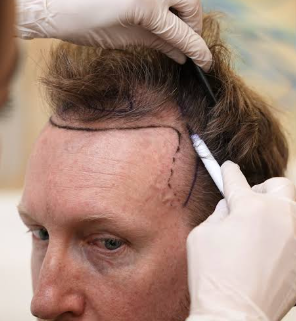
A low and dense juvenile hairline can consume substantial grafts that might be needed later as hair loss progresses. The design should suit facial proportions, age, future loss patterns and available donor supply. A mature, natural-looking hairline may provide a more sustainable plan than copying a celebrity photograph. Ask how density will be prioritised among the frontal zone, temples, mid-scalp and crown. Different areas are not equally visible from every angle, and the surgeon must balance cosmetic impact with anatomical limits. A hairline design consultation should be a medical planning discussion rather than an aesthetic drawing alone.
Crown restoration requires careful budgeting
The crown or vertex can cover a relatively large area and may require many grafts for a modest-looking increase in coverage. Its spiral hair direction also presents a distinctive planning challenge. Patients with both a receding frontal hairline and crown thinning may need to prioritise one region based on expected benefit, donor reserve and personal goals. A surgeon might advise staged treatment or lower density rather than using the entire donor resource in one procedure. Ask what result is realistically achievable and what future loss might expose. Density should never be guaranteed based on an online crown photograph.
Planning for ongoing native hair loss
Transplanted follicles may behave differently from native hair that continues to thin with age. As surrounding hair is lost, the original transplant can appear isolated or uneven unless the plan considered progression. The clinician should evaluate family history and discuss evidence-based medical management where appropriate. Prescription treatments have contraindications and possible side effects and require qualified medical advice. A transplant does not cure the underlying process of hair loss. A patient who values long-term appearance should ask how the proposed hairline and graft allocation would look if additional native hair disappears in later years.
What if a second procedure is needed?
Some patients seek greater coverage or a later procedure after their hair loss pattern changes. However, the possibility of future surgery is limited by remaining donor supply, the scalp’s condition and previous extraction. Ask the surgeon to document the first session’s actual graft count and donor sites so a future clinician can evaluate the remaining reserve. Do not assume that a second session can safely repeat the first graft number. Scar patterns and tissue changes may influence planning. An initial procedure that respects donor limits can preserve more options than aggressive extraction intended to achieve maximum short-term density.
Using beard hair as additional donor supply
In selected cases, beard follicles may be considered as a supplementary donor source, but they differ from scalp follicles in calibre, texture and growth characteristics. Harvesting can also leave visible marks or affect the appearance of facial hair. A clinician should assess the patient’s beard density, skin type and suitability rather than treating beard hair as an unlimited reserve. Such grafts may be considered for selected regions or blending strategies but are not a universal substitute for scalp hair. Discuss professional roles, extraction technique, risks and realistic expectations. Existing site material about beard hair offers background, not a personal indication.
Donor appearance after extraction
A donor area may experience scabbing, redness and temporary changes in appearance during early healing. The duration varies depending on extraction, skin characteristics and postoperative care. Patients should follow the clinic’s washing instructions rather than pick crusts or apply unapproved products. Persistent worsening redness, discharge, fever or severe pain requires medical assessment. A shaved donor region can make extraction points more visible during early recovery, but that does not mean all changes will disappear without trace. Ask how the donor region is expected to look with the hairstyle you normally wear.
Afro-textured or curly hair considerations
Curly and tightly coiled hair may follow curved pathways beneath the skin, creating particular challenges during extraction and increasing the importance of suitable expertise. The surgeon should discuss hair characteristics, possible transection risks and an appropriate plan after examination. It would be misleading to promise the same graft yield or extraction method for every hair type. A patient with darker skin may also have individual scarring or pigmentation concerns that deserve consideration. Ask to discuss relevant experience and realistic outcomes with the treating medical team. Avoid relying on generic stock photographs that do not match the patient’s hair characteristics.
Women and diffuse donor thinning
Women considering transplantation may experience patterns of thinning that involve more than the frontal hairline. Some forms of hair loss affect the donor region itself, making transplantation unsuitable or requiring careful medical investigation first. A doctor should establish the likely cause of hair loss and review medical conditions, medicines and the scalp before proposing graft extraction. Hairline lowering or eyebrow restoration may have different requirements from treating widespread scalp thinning. A preliminary photo consultation should not guarantee that a woman will be an appropriate surgical candidate. Conserving donor supply is particularly important when the expected pattern is uncertain.
DHI, Sapphire FUE and donor protection
The extraction stage and the implantation approach should be discussed separately. A technique advertised as DHI or Sapphire does not automatically make donor harvesting safer. The number and distribution of follicular units removed, the appropriate extraction instruments and professional experience matter to donor preservation. Ask how extraction sites are spaced, how graft quality is assessed and who performs the relevant surgical steps. A premium device name should not substitute for a documented plan. The doctor may select a method based on the area being treated, remaining hair and patient needs rather than promising universal superiority of one technique.
Before-and-after photos need the donor view too
Advertising galleries often focus on the frontal hairline, where visible cosmetic improvement is most dramatic. A fair assessment should also consider the donor region and photographs taken under consistent conditions. Ask whether the patient had additional treatment, how much time passed between images and how short the donor hair was cut. Good-looking front images alone do not establish that the donor area was preserved appropriately. Individual consent and privacy should govern publication. A patient can request a discussion of realistic outcomes without treating another person’s result as a promise. Hair characteristics and the number of usable grafts differ.
Recovery, sun and coastal travel
Bodrum’s strong summer sunshine and appealing beaches should not distract from early scalp care. Ask the clinical team when direct sun exposure, tight hats, helmets, swimming pools and sea bathing may be resumed after the specific procedure. Do not assume a generic timeline applies to every patient, especially if skin healing is delayed. A quiet hotel and sensible airport transfer may be more suitable than a busy beach programme immediately after treatment. The doctor should provide written washing and activity restrictions and arrange review as needed. Delaying a recreational boat trip can be more important than preserving a holiday itinerary.
When a transplant may not be the best option
Some patients have insufficient stable donor supply, active scalp conditions, unrealistic expectations or a type of hair loss that needs diagnosis and treatment rather than surgery. A clinician may recommend monitoring, medical management or no procedure. This should not be viewed as poor service. Choosing not to remove donor follicles can be the safest decision when future hair loss is uncertain. Patients should be informed about risks, alternatives, potential scars and the limits of achievable density. An online package advertisement cannot determine who should undergo surgery. An honest consultation includes the possibility that transplantation is inappropriate.
Frequently asked questions
Can the donor area grow every extracted follicle back?
No. Harvested units are relocated; the donor supply is finite.
Can I safely request 5,000 grafts?
Only an individual examination can determine an appropriate graft plan.
Does DHI prevent donor scarring?
No technique eliminates all scarring risk.
Can beard hair replace scalp donor hair for everyone?
No. It is a selective option requiring clinical evaluation.
Should a low hairline be a priority?
The design should reflect anatomy, donor reserve and potential future loss.
Ask for a long-term donor plan
Prospective patients should ask a qualified clinician to evaluate the donor area and explain how grafts may be distributed between the frontal hairline, mid-scalp and crown without unnecessary overharvesting. The plan should account for ongoing hair loss, possible future treatment and the patient’s normal hairstyle. Hair Transplant Bodrum can help coordinate an enquiry, but only the medical team can decide suitability and surgical technique. Existing beard-donor, hairline-design, recovery and DHI articles provide related information. This page offers general education, not personalised medical advice; results and recovery vary between individuals.